
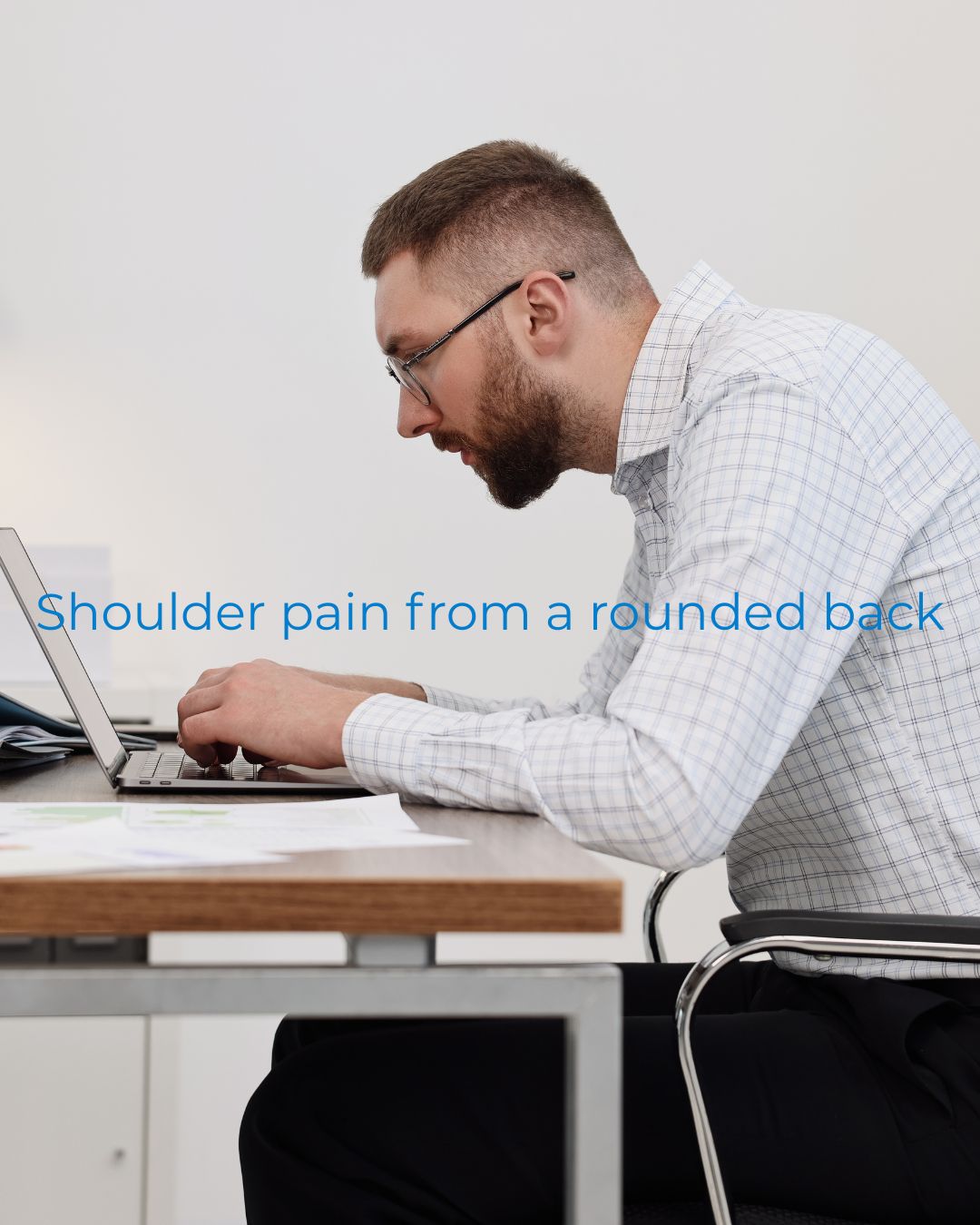
When your shoulder hurts, it’s natural to focus entirely on the shoulder. But some of the most stubborn shoulder problems we see at Pottsville & Cabarita Physio have a hidden accomplice sitting just below and behind the joint: a stiff thoracic spine — the mid-back region between your neck and lower back.
If you’ve been diligently doing shoulder exercises and still feel stuck, this article might explain why.
Meet the thoracic spine
Your thoracic spine is the twelve-vertebra section of your back that your ribs attach to. It’s built more for stability than for big movement, but it still needs to flex, extend and — importantly — rotate to let your arms move freely overhead.
Here’s the key connection: your shoulder blade (scapula) glides across the back of your ribcage, and your arm’s full range depends on that shoulder blade moving well. The scapula is effectively the link between your spine and your arm. If the ribcage and mid-back underneath it are stiff, the shoulder blade can’t position or move optimally — and that changes how much load lands on your rotator cuff, especially when you reach overhead.
What the evidence says
This isn’t just theory. A 2024 study comparing people with rotator cuff related shoulder pain (RCRSP) to pain-free controls found the RCRSP group had significantly reduced thoracic spine mobility — less rotation to both sides, and altered flexion and extension. They also had reduced neck rotation and higher neck-related disability scores.
The researchers’ practical conclusion was direct: clinicians should assess the neck and thoracic spine in people with shoulder pain, not just the shoulder itself. Reduced mid-back movement can alter how the shoulder blade moves, which increases stress on the rotator cuff tendons — particularly during overhead activity.
There’s also a body of research exploring whether treating the thoracic spine directly — through mobility work and hands-on techniques — helps shoulder symptoms. The evidence for adding thoracic spine treatment alongside exercise is promising, and enough to make thoracic assessment a routine part of good shoulder care, even though researchers are still refining exactly how much it adds on its own.
Who tends to have a stiff thoracic spine?
We see reduced mid-back mobility across all sorts of people on the Tweed Coast:
- Desk workers and drivers — hours in a rounded, static position.
- Parents of young kids — endless bending, carrying and feeding postures.
- Tradies and gardeners — repetitive forward-and-down work.
- Older adults — the mid-back naturally tends to stiffen with age.
- Overhead athletes — surfers, swimmers and paddlers who need every degree of rotation they can get.
A word of reassurance, though: a rounded upper back or “poor posture” on its own is not a reliable cause of shoulder pain, and you don’t need to obsess about sitting up ramrod-straight. The evidence doesn’t support the idea that thoracic kyphosis(the natural forward curve) directly causes shoulder pain. What matters more is available movement — whether your mid-back can move when you need it to — rather than the shape it rests in.
How we check it
During a shoulder assessment, we’ll often ask you to rotate and extend through your mid-back, and we’ll watch how your shoulder blade moves as you lift your arm. A useful clinical test: if repositioning your shoulder blade changes your shoulder pain, that points us toward the scapula and thoracic region as part of the story. It’s one of the ways we work out where to aim treatment.
What you can do about it
The good news is thoracic mobility responds well to simple, consistent work. A few of our go-to strategies:
- Thoracic rotations — on all fours or seated, rotating the upper back one side at a time.
- Extension over a foam roller — gentle mobilisation of the mid-back.
- “Open book” stretches — lying on your side, rotating the top arm open.
- Reaching and rotating drills that combine mid-back movement with shoulder motion.
- Regular movement breaks if you sit or drive for long stretches — the best posture is usually your next posture.
Paired with progressive rotator cuff strengthening, restoring mid-back movement often unlocks shoulder progress that’s been stalling.
The bigger picture
The take-home message of both this and our companion RCRSP article is the same: the shoulder is part of a system.Treating it in isolation — or worse, treating a scan report in isolation — misses the connections that often matter most. Good physiotherapy zooms out, assesses the neck, mid-back and shoulder blade together, and builds a plan around how you move.
Feel like your shoulder rehab has plateaued? It might be time to look above and below the joint. Book in with Pottsville & Cabarita Physio for a full assessment. Get in touch.
Written by Melissa Macdonald, Physiotherapist & Pilates Instructor, Pottsville & Cabarita Physio.
This article is general information and not a substitute for individual assessment. Please see a physiotherapist or doctor for advice specific to you.